Monday, August 17, 2009

Holy Smokes! A Starred Review!


I learned this morning that "Sunflowers" has received a starred review from Publishers Weekly! What a nice surprise and a wonderful way to start the week. Here is the text (the star didn't copy/paste...). Needless to say I'm positively giddy!

Sunflowers: A Novel of Vincent Van Gogh Sheramy Bundrick. Avon, $14.99 paper (432p) ISBN 978-0-06-176527-8

In a knockout debut novel, art historian Bundrick (Music and Image in Classical Athens) brings Vincent Van Gogh's paintings and personal story to vibrant life. While Bundrick takes many liberties (recorded in an author's note) in her fictionalized account of Van Gogh's affair with her narrator, fille de maison Rachel Courteau, she gives Rachel such a believable voice that the proceedings seem genuine. At 35, Van Gogh meets lovable spitfire Rachel while surreptitiously sketching her in a garden. Having taken refuge in an Arles brothel after the death of her parents, Rachel greets Van Gogh as a customer not long after, and soon feelings blossom between them. Visiting friend Paul Gauguin and the cloud of Van Gogh's madness undercut the couple's bliss, as do financial troubles and Rachel's life at the maison, where she's kept a virtual prisoner. While infusing well-known historical moments (like Van Gogh's infamous self-mutilation) with vivid details, humanizing Van Gogh and putting his famous works in context, Bundrick generates an impressive volume of suspense, delight and heartbreak. (Oct.)

Thursday, August 13, 2009

A Van Gogh Mystery

Police in Santa Fe are asking for the public's help with a burglary from an artist's home of about $750,000 worth of artworks, jewelry, and artifacts, including an alleged charcoal drawing by Vincent van Gogh. The Santa Fe New Mexican posted an article today about the heist but unfortunately provides no photographs of the drawing. The homeowner describes the drawing as a 14-by-17 inch charcoal preliminary sketch of the "Night Café" painting in the Yale University collection (the same painting that currently is entwined in its own legal battle) and says it is identical to the painting except that it lacks VIncent's signature.

This story intrigues me, and not because of the theft. This drawing -- if it is indeed by van Gogh -- is unknown in the canon, as far as I've been able to find out. It is not in the de la Faille catalogue raisonné, and it is not mentioned in the scholarship surrounding the Night Café painting. The homeowner says that his great-grandfather bought the drawing and it has been in his family ever since: how can van Gogh experts not know about it? And another point ... when Vincent was living in Arles in September 1888, at the time he did the Night Café painting (and the watercolor version of the painting today in a Swiss private collection), his drawing materials of preference were pencil and/or ink/reed pen. Not charcoal.

I would really like to see a photograph of this drawing. According to the article, experts at Yale have been brought into the case. I would also really be curious to know what they have to say.

UPDATE (20 Sept 2009): On 9/11 the Santa Fe New Mexican reported that the alleged van Gogh drawing was discovered, along with the other artworks allegedly stolen from the home, at a consignment shop in Raton, on sale for $250. The whole thing smells odd to me: to quote John Turturro in "Oh Brother Where Art Thou" -- "That don't make no sense." Among the comments on the article about the recovery (which are otherwise pretty silly), David Brooks from the online Van Gogh Gallery (www.vggallery.com, the best non-museum Van Gogh site there is) rightly points out that "There is no such known van Gogh drawing. Saying it's a van Gogh doesn't make it a van Gogh." He's got that right.

Helen of Troy

I've been 'into' Greek mythology for about thirty years now (gasp! I'm old!), and I have to say, I never liked Helen of Troy much. She always struck me as the kind of person I would not like being around, and she always struck me as being enormously selfish. But reading Margaret George's "Helen of Troy" this summer has given me a different perspective into this character, and for that I have to thank Ms. George and her terrific storytelling. I hadn't read "Helen of Troy" before now because I feared it would annoy me as much as the movie "Troy" had done -- but Ms. George's keynote speech at the Historical Novel Society conference convinced me to give it a whirl. I'm glad I did!

Ms. George had a lot to contend with in crafting this story. The Iliad only covers one small part of the Trojan War saga; there are many other tales woven into the mythological tradition, and unfortunately, we know about several epic poems that no longer exist. Ms. George admirably brings together all the threads of the story: she even brings in the Amazons (readers may think she made up the Amazons coming to Troy for her novel, but she did not--a now-lost epic poem called the Aithiopis detailed this episode). At the same time, she introduces enough of her own flourishes to create a cohesive tale and flesh out the narrative. The Bronze Age isn't my academic specialty, but I've read enough of the scholarship to recognize that Ms. George has read it too. She captures the spirit of the times and introduces some of the latest archaeological findings while avoiding the dreaded 'research dump.' Those who are familiar with the mythological tradition will find plenty of places to smile, appreciating the way Ms. George deftly incorporates this or that detail.

Ms. George's Helen is a complex character. The novel is told in first person, which allows the reader to engage closely with Helen and understand her choices a bit more (even if the reader does not agree with them). For Helen, her beauty is a curse, and while there is a bit of "don't hate me because I'm beautiful" here, it works with the story. The scenes of the Ilioupersis (Fall of Troy) are particularly moving.

The one quibble I have concerns Achilles. True, in the Iliad Achilles acts like an arrogant jerk, but in Ms. George's novel he is the one character who is basically two-dimensional. Also true that Helen does not have an opportunity to 'get to know' Achilles, but Ms. George changed something that troubled me, the only time in reading the entire book that I went "nooooo!" In the Iliad the so-called Ransom of Hektor scene, when king Priam visits Achilles in his tent to retrieve his son's body, is the turning point of the entire poem. It is Achilles' redemption. (In fact, it's the only episode that the movie "Troy" got close to right.) But Ms. George adds a 'postscript' of sorts to that scene -- something Achilles demands of the Trojans the morning after -- that is not in the Iliad. And I have to say, that 'postscript' spoils the character of Achilles as we know it from the Homeric tradition. Most readers might not notice or care, but it disappointed me. For all Achilles' faults, I love that guy!

That one quibble aside, I loved this book, and I recommend it to anyone who enjoys Greek myth and seeks a retelling that is faithful to the spirit of the original stories.
Monday, August 10, 2009

At The Bookbinders!


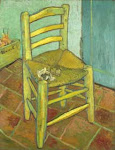
The Van Gogh Museum announced on Facebook today that the six volume new edition of Van Gogh's letters is now at the bookbinders. They've posted photos of the stacks and stacks o'manuscripts at Flickr. (Photo of a sample set from Amazon.com.)

Somewhere in those stacks is the set that will come to ME in October, preordered months ago from Amazon. I'm totally geeking out here.

:-) :-)

Wednesday, July 29, 2009

On This Day...

On 29 July 1890, not long after midnight, Vincent van Gogh breathed his last in an attic room of the Auberge Ravoux at Auvers-sur-Oise, the victim of a self-inflicted gunshot wound to the abdomen. His brother, Theo van Gogh, was with him.

Rest in peace and sunlight, mon ami.

Thursday, July 23, 2009

Keeping Up Appearances

I am happy to announce my first appearance/book-signing: Saturday 24 October at the St. Petersburg Times Festival of Reading, to be held at my lovely waterfront campus, the University of South Florida St. Petersburg. I'll be giving a 30-40 minute illustrated talk on "Writing Van Gogh's World" and signing books (available for purchase at the venue). I've asked if I can speak in my teaching classroom for maximum comfort and convenience! The Festival of Reading is in its seventeenth year and is the largest such event in the Tampa Bay area. Each festival features an array of Florida and national authors, a special series of kids activities (including a storytime with local celebrities), and in general is a fantastic event to promote reading and literacy. The final schedule and lineup are not yet posted on the Festival of Reading website, but some of the author bios are (including mine), and more information will appear as the day draws close.

Especially for USFSP students, I'll be giving a talk on "Why (and How) I Became a Historical Novelist" on Tuesday November 4th as part of the Faculty In Residence lecture series. I'll sign books if students bring 'em, and I'll be giving away a copy as a door prize.

I've been invited to another Florida book fair in spring 2010, but since it's not a signed-sealed-delivered deal yet, I'd better not say which. I'll be part of a panel on debut novelists.

Luckily for me speaking in public and giving lectures is my job ... and more than that, my passion!

Saturday, July 18, 2009

The Elusive Vincent


The Clever Pup -- who commented on my last blogpost, thus inspiring me to go immediately to her blog -- has a good post about this alleged photograph of Vincent van Gogh. I ran across the claim myself a while ago, and for the record, I don't think it's him (neither does The Clever Pup). The person in the photograph is too old, for starters (Vincent was only 33 in 1886, the date claimed for the photograph); two, Vincent didn't like photographs in general, he didn't like his own appearance, and I can't see him posing for a professional photograph; and three, as The Clever Pup points out, Saint Hyacinthe, the home of the photographer, is in Canada. Vincent never went to Canada. For most of 1886, from March onward, he was in Paris living with Theo.

The only confirmed photograph of Vincent as an adult -- there are two of him as a teenager -- shows him from the back, sitting on the banks of the Seine at Asnières with Émile Bernard.