Wednesday, June 17, 2009

Bats in the Belfry


I think I have a bat colony living in my apartment building.

Clue #1: An actual bat emerged from my laundry room one night last week and flew like a, um, bat out of hell across my living room. BAM! He ran into my bookshelf and fell to the floor. (That blind as a bat business is no lie.) I crept close to see if he was dead; he didn't move. I poked him with a broom--he squeaked--NOT DEAD! Ahhhhh! I opened the balcony door, and once he had recovered from his daze, I persuaded him to crawl outside. (Translation: I beat the floor beside him with a broom and yelled "Get Out Damn Bat!" à la Lady Macbeth at the top of my voice until he inched his way out. This barefoot and in me nightie at 11pm.) In the morning, he was gone, having I assume recovered and flown away. And I cardboarded and duct-taped the place where I think he came from, a crevice around the washer hook-up. Told the nice lady in the leasing office as a heads-up, thought he was probably a loner, and went to HNS, forgot the whole thing.

Until...

Clue #2: Just now I went into my bathroom and switched on the light. Commotion behind the wall that sounds a lot like squeaking bats. Ahhhh! They can't get in, I know that (thank you duct tape), but it's freaky deaky! I have called leasing office and nice lady is getting the Critter Master (yes, that's his name) out here asap to check it out. I'm on the third floor, so it is possible bats got into the attic somehow and have taken up residence. My complex abuts wetlands, and apparently loads of fruit-bats live in the mangroves. Nice. Am hoping they go back to sleep and do not squeak any more.

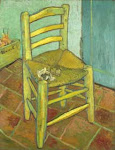
So what the heck does this have to do with van Gogh? Why, he painted a bat once (click on image to enlarge), and I've been looking for an excuse to post this fairly well-known picture. It's actually a stuffed bat that he might have seen in a fellow artist's curio collection in Holland. The painting, known as "Flying Fox," dates from autumn 1885 based on the style and color palette. I was intrigued to note while finding an online image that the CDC used this painting on the cover of a 2002 journal on infectious diseases involving, you guessed it, bats. Luckily -- despite the array of prehistoric wildlife that live in my adopted state of Florida -- this is NOT the kind of bat currently co-habitating with me. Wee three-inch fuzzy critters is more like it. But they need to bat it, um, beat it. Asap!

Hearing Voices

At one of the Historical Novel Society conference panel discussions, an aspiring writer in the audience asked Margaret George how to handle questions about a character, for example, if one is not sure how a character should look. "Ask her," Ms. George said calmly. "She'll tell you."

Once I would have tittered at this and thought it rather loopy-lou, but now it seems natural, as it probably did for many writers in the audience that day. Characters DO talk to you once you've gotten to know them, and while at first it seems rather scary and schizophrenic, if you let them have their say, you'll have your story. While writing "Sunflowers," I would wake up in the middle of the night and have somebody's lines ready to scribble down, or in the shower, or driving in the car...at a certain point, it was like being a scribe for Imaginary Friends. At lunch one day during the conference, a fellow author asked me did I ever have dreams with my characters. She had, she admitted, experienced a dream recently with a character in her current project where he was quite grumpy with her and urged her to keep working on his story. (He's a historical person, this character, not fictional.) Yes, I answered, but only once. Vincent appeared in one dream about six months into my writing, when I was finally getting the swing of it and really starting to hear the characters. What did we talk about? I don't remember, but I remember he hugged me, and I woke up feeling very peaceful and cozy inside. The author I was speaking with nodded her head. "He was happy," she said. "Happy you were telling his story."

So how does one reach this state of total connection with one's characters? Margaret George, in her keynote speech at the Saturday night banquet, discussed some of her methods: obtaining clothes, jewelry, objects somehow related to the characters and keeping them near; traveling to the places they were; playing music from their time period to create a mood; keeping pictures of relevant artworks nearby. While writing her book on Cleopatra, she even obtained perfume that she felt evoked the character and wore it while she worked. For "Sunflowers," I wallpapered my writing corner with van Gogh paintings cut-out from old calendars, and while I can't listen to music while I write, I did play something from Debussy or other composers from Vincent's time just before starting to work. Getting into his head, though, was easily done through reading his letters. That's how I really started to hear him speak. As for Rachel, she appeared quite naturally, and once she did, I couldn't keep her quiet! There's something magical about it, really, when your creative mind is so active and engaged that the characters' voices flow without prodding. (Writing arguments, I found, is especially fun--suddenly somebody lets loose a real zinger, and you think "Ho! She did NOT go there!" and chuckle with glee as you type the line.) And in some ways, it can't be forced, no matter how many tricks you use. Relaxing and *listening* is the key. They'll talk. Just give them time.

Tuesday, June 16, 2009

Boy, oh Boy!

Further musings about HNS are officially interrupted by the Van Gogh Museum's announcement today about the exhibition "Van Gogh's Letters: The Artist Speaks," which will be held at the VGM from 9 October 2009 to 3 January 2010. *120* of the original van Gogh letters from the museum's collection will be exhibited alongside paintings and drawings he wrote about. An additional three letters written to artist Emile Bernard will be on loan from the Pierpont Morgan Library. 340 total manuscripts, paintings, and drawings will be on view in the show, the largest devoted to Vincent's correspondence. Holy cow. The Plot to Get to Amsterdam After Fall Term Ends is now underway...

In other VGM news, the museum announced that a whopping 530,000 people visited the "Van Gogh and the Colors of the Night" exhibition during its Amsterdam showing. That's half a million people in three months, one of the best-attended shows in the VGM's history. Again I say it -- Holy cow. Vincent kicks attendance butt AGAIN!

Monday, June 15, 2009

Blast About the Past

The Historical Novel Society conference this past weekend was FABULOUS!! So much fun, meeting fellow writers and readers, putting faces to names. Panels on everything from fact vs fiction in historical novels to marketing/promotion were interesting and helpful, as already-published authors shared their ideas and experiences. I came away with a lot of ideas and thoughts on the craft...and very jazzed up about promoting "Sunflowers" and working on my new project!

I roomed with Julianne Douglas over at Writing the Renaissance, who's been my online buddy for over a year but I'd never met her in person. It was a giggly girly slumber party! I was happy to spend quality time with Catherine Delors, another online friend: now I want to reread her marvelous "Mistress of the Revolution" so I can hear her lovely French accent in the words. And so many other folks I enjoyed meeting and chatting with, whether it was only for a few minutes or for longer: Lucy Pick, Laurel Corona, Christine Blevins, Vanitha Sankaran, Michelle Moran...the list goes on and on. Everyone was so nice and friendly, and so excited about books and history, that everybody you met became an instant friend. The networking was as good as the panel discussions, if not better. The organizers deserve great big kudos for their hard work in giving attendees a well-run and enjoyable experience.

And yes, it was very different from academic conferences, as I suspected the other day. Academic conferences do not have costume contests or late-nite sex scene readings, and they sure don't come with tote bags of free books!

I'm still mulling over things I heard and saw at the conference, so I'll be posting more thoughts, I'm sure...

Thursday, June 11, 2009

Off to HNS

This weekend I'm heading to the Historical Novel Society conference up in Schaumburg, IL. It's my first writers' conference -- yeah, I wrote a book then went to a conference, how backwards is that? -- and I'm really looking forward to meeting other authors and readers. Some I've already met online in the blogosphere, and it will be fun to put faces to names. It's going to be a fun gathering, generally: some of the authors attending are Sharon Kay Penman, Diana Gabaldon, Michelle Moran, Catherine Delors, and Laurel Corona. It's also going to be chilly, from my Florida POV, with highs only in the low 70s and lows in the 50s. Considering it's over 90 here today, I'd better excavate a sweater and rethink my wardrobe!

I'm curious to see how different a conference like this is from the academic conferences I'm accustomed to. The 'big' conferences of the professional organizations (I belong to College Art Association and Archaeological Institute of America) can be daunting, especially to a newbie. I only go to those when I'm presenting a paper, because I don't find them much 'fun.' It's nice when they're held in cool cities, but otherwise it's a lot to take in and more than a little hectic. Smaller, themed symposia and conferences to me are much more enjoyable; I've been lucky to present at a few of those in the past few years. Since I'm not presenting anything at HNS (or interviewing for a job, another aspect of the big academic conferences), I'm free to relax and have fun. Mix, mingle, network. And get free stuff, evidently! Organizer Sarah Johnson (who blogs on Reading the Past) has promised tote bags of goodies. Yippee!! Am leaving room in the suitcase...

I'll report back on my HNS experience next week. Here's hoping it's a fabulous weekend!

Wednesday, June 10, 2009

Happy Birthday, Monsieur Courbet


June 10 is the birthday of Gustave Courbet (1819-1877), easily one of art history's most groundbreaking and controversial painters. Audiences in his time either loved his work or loathed it, and now, of course, he enjoys a special place in textbooks as the founder of the French Realist movement in art. "Show me an angel and I'll paint one" is one of his famous quotes, making the point that painting should celebrate all that is real and modern. In the textbook I use for art history survey, "The Burial at Ornans" (1848) and "The Stonebreakers" (1849) are featured; it takes some explaining to demonstrate why those particular examples were so scandalous back at the Salon of 1850, but they were. Requiring no explanation -- and maintaining their shock value -- are other of Courbet's canvases, most notably "L'origine du monde" ("The Origin of the World"), an up-close-and-WAY-too-personal painting of a woman's hoo-ha. (I don't show that one in class!) Today "L'origine du monde" hangs in the Musée d'Orsay in Paris, and it's one of those artworks where it is really, really fun to watch people come around the corner and encounter it.

Van Gogh was a great admirer of Courbet and mentions him several times in the letters to Theo. In December 1888, van Gogh and Gauguin traveled from Arles to Montpellier to see the Bruyas collection housed in the Musée Fabre (still there), including the pictured painting, "Bonjour, Monsieur Courbet" (1854--click image to enlarge). Courbet stands at the right with walking-stick; he's come to the south of France on a painting expedition. Collector Alfred Bruyas is the redhead in the center (van Gogh muses in his letter to Theo that he somewhat resembles Bruyas). Perhaps the most tame and least controversial of all Courbet's paintings, "Bonjour, Monsieur Courbet" was one of the most famous canvases of its day.

Thursday, June 4, 2009

Meet My Bookcover!


At last, I have a jpeg of the final cover art for "Sunflowers" to post and share -- and here it is! (click image to enlarge)

At the risk of sounding like I've been drinking the kool-aid in the graphic design department (as it happens, I'm the chair of that program...boy, is that a long story), here's a little discourse on my cover. First of all, I didn't realize how important book covers actually were until we got into the drafts and discussions: with my Cambridge Univ Press scholarly book, it was important, but not quite in the same way. This one needs to appeal to not only readers but the 'gatekeepers'...the folks representing bookstore chains, the independent booksellers, etc, etc. It needs to grab attention and make everyone want to pick up the book--because people DO judge a book by its cover. I really wanted a van Gogh original image, and said so from the beginning. The design team had other things to consider, too, namely the "Sunflowers" title, which automatically limits the image somewhat. (As in, people would expect to see a flower or two.) I also suspect the one-word title vs five-word subtitle vs fifteen-character author name came into play when it came time to do actual typographic layout. Everything needed to fit nicely and look good.

I wish I could post the two previous drafts and share details about the discussions, but I bet that wouldn't be very diplomatic. Sufficient to say, there *were* discussions, and this is the final result. I'm pleased myself! Not only is a van Gogh original being used -- this is a detail from the August 1888 Sunflowers now in Munich -- but I particularly like the typeface for the subtitle and my name, which looks rather 19th-century. Choosing this particular detail of the painting lends a certain turbulence that hints at the emotional turbulence present in the story itself -- the crowding of the flowers, the lines of the petals. And a 'zoom-in' like this reveals the texture of van Gogh's brushstrokes, which is always hard to convey in a photograph.

Hope everyone likes! Feel free to share your thoughts...