

 Posts


The first version of "Vincent's Bedroom in Arles" -- painted in Arles in October 1888 -- returns to display today in the Van Gogh Museum, following an intensive and successful six-month restoration. A special display, "Bedroom Secrets," reveals the conservation process and complicated history of the painting for visitors. But hurry: the mini-exhibition of "The Bedroom" will only remain in Amsterdam until September 19th; after that, the picture heads to Japan for a Van Gogh retrospective co-organized by the VGM and Kröller-Müller Museum.
More details, including before-and-after photos and an account of the conservation process, can be found on the Van Gogh Museum's website and on the conservators' blog, Bedroom Secrets. My hat's off to the conservators for a fantastic job: even in photographs, one can see how much brighter the colors are after cleaning, details previously obscured now more visible. Most importantly, this painting, which was in a very fragile condition prior to restoration, is in a much safer state. The fact the VGM is sending it to Japan shows how confident the museum is; it almost never traveled in recent years because of its condition. I enjoyed reading the conservators' updates throughout the process and their interesting discoveries. Congratulations to the VGM on what must be a very exciting day!
Showing posts with label Arles. Show all posts
Showing posts with label Arles. Show all posts
Friday, September 3, 2010

Sunday, March 14, 2010
Renovating "The Bedroom"

Visitors to the Van Gogh Museum in Amsterdam between now and August will be looking in vain for one of the VGM's most beloved paintings, "Vincent's Bedroom in Arles" from October 1888 (click image to enlarge). That's because "The Bedroom" is receiving much-needed conservation work, the last major campaign of restoration on the painting having taken place in the 1930s. But leave it to the very plugged-in Van Gogh Museum to bring virtual visitors into the process: the museum has launched a blog wittily titled Bedroom Secrets, in which head of conservation Ella Hendriks will post week-by-week progress on the project. Presumably the team will not only be restoring the "The Bedroom" but doing some research on its pigments, canvas, etc., continuing ongoing study of Vincent's painting materials.
Some of the damage to "The Bedroom" that the current conservation will seek to stabilize dates back to Vincent's own day. In a letter to Theo before leaving for the hospital of Saint-Rémy in spring 1889, Vincent explains that during his most recent stay in the hospital at Arles, flooding from the Rhône River and the spring rains had created a damp atmosphere in his house and "The Bedroom" was particularly affected. "There's one which is flaking onto which I've stuck newspapers," he says, and at another point tells Theo he believes "The Bedroom" will need to be relined or recanvassed completely. Vincent must have been distressed at the damage to this painting, for his letters to both Theo and Paul Gauguin from mid-October show he was very proud of it. "Looking at the picture ought to rest the brain, or rather the imagination," he says in a letter to his brother and crows about the effect of simplicity he had sought to attain. After Vincent's initial breakdown in late 1888 and his first return to his house, he wrote to Theo (January 1889): "When I saw my canvases again after my illness, the one that seemed the best to me was my bedroom." Once Theo received the painting in Paris in May 1889, he was concerned enough himself about the damage that he sent it back to Vincent in Saint-Rémy to copy (this copy is today in the Art Institute of Chicago and dates from Sept 1889). Still proud of "The Bedroom," Vincent of his own accord made a second, smaller copy as a gift for his mother and sister; this version hangs today in the Musée d'Orsay in Paris.
Vincent created the Amsterdam version of "The Bedroom" during a period of hard work, when he says to Theo he had been exhausted and in need of deep rest. For him, the bedroom scene evoked calm and tranquillity; he also used the composition as an opportunity to explore complementary color pairs and a flatness of tone that he felt was Japanese influenced. It is interesting to note in all three versions the peculiar shape of the room: it would be easy to think Vincent was "off" in his perspective or that the distortion was somehow due to his mental state (yes, this has been claimed)...except that his room really was shaped that way. The so-called yellow house no longer exists, having been damaged by Allied bombing in World War II and later torn down, but surviving ground plans make the trapezoidal shape of the bedroom very clear. Some have also noted the dual chairs and dual pillows in the room, as if Vincent imagined a second occupant (i.e. the wife he always wanted); however, he does not explain that detail in his letters. There is no doubt that "The Bedroom" and the pride Vincent felt in this painting echo the love and pride he felt for his little yellow house. He had moved all his possessions into the house in September, and judging from the detailed letters he sent his brother, put much thought, care, and money into the house's decoration and upkeep. Even though rented, the yellow house was the first home Vincent had that was completely his--it was his refuge, the locus for all his hopes and dreams. It's no surprise he immortalized one of its rooms on canvas.
Sunday, February 14, 2010
A Snowy Day

No snow on the ground here in Tampa Bay, of course, but since much of the rest of the country -- including my hometown in Georgia -- has at least a few inches lying around, seems a good time to introduce one of van Gogh's rare snowscapes. "Snowy Landscape with Arles in the Background" (click image to enlarge) dates from late February or early March 1888, just after Vincent arrived in Arles. He'd stepped off the train on February 20th to a surprising sight: about 12 inches of snow covering the Provençal landscape. The irony? Well, firstly that Arles rarely saw that kind of snowfall, and secondly, that van Gogh had come south seeking the sun and a warmer climate. In a letter to Theo after his arrival, he expressed surprise at the weather but then added optimistically that the snow-blanketed landscape reminded him of some Japanese prints.
"Snowy Landscape" shows a view of Arles that Vincent would later depict in summer: the city's skyline distant on the horizon, a vast, flat field in between. We can spot the towers of the various churches, including Saint-Trophime, as well as smokestacks of the PLM railway workshops. Appropriately for the wintry day, no figures can be seen, although footprints dot the snow...the artist's own? The composition of this painting recalls seventeenth-century Dutch landscape painters such as Jacob van Ruisdael, whose work Vincent admired, although Ruisdael's landscapes tend to show a more expansive sky. Lest we think this snowy landscape is too melancholy, van Gogh includes hints of green, suggesting some plants have survived the snowfall and wait eagerly for spring. Just like Vincent himself must have done!
Saturday, January 2, 2010
Painting the Wind

"I've already had an opportunity to find out what this mistral's like too. I've been out on several hikes round about here, but the wind always made it impossible to do anything. The sky was a hard blue with a great bright sun that melted just about all the snow -- but the wind was so cold and dry it gave you goose-pimples." -Vincent to Theo, 9 March 1888, writing from Arles
It came in the middle of the night. BANG! I sat up with a start in my room on the top floor of a hotel in Arles, then scurried to the window to secure the shutters. Oh yes, it was...
The MISTRAL!
I was very excited. Unlike many visitors, who'd rather not have their Provence vacations disrupted by a cold northwest wind, I was eager to feel the mistral for myself, because I was writing about it in "Sunflowers." While in Arles, Vincent hated the mistral, because it made it difficult to paint outdoors. By summertime he had concocted a solution, as he explains to painter friend Émile Bernard in a letter from June 1888: "My easel was fixed in the ground with iron pegs, a method that I recommend to you. You shove the feet of the easel in and then you push a 50-centimeter-long iron peg in beside them. You tie everything together with ropes; that way you can work in the wind." Even so, he had plenty of complaints, calling the mistral "a very nasty, nagging wind" (letter to sister Wilhemina, 31 July), "the devil" (letter to Theo, 18 August), and any number of other adjectives...aggravating, pitiless, violent. The mistral is mentioned many times in the Arles letters. Although there was mistral in Saint-Rémy as well, Vincent had fewer problems there. "The mistral (since there are a few mountains here) appears far less annoying than in Arles, where you always get it at first hand" (letter to Theo, ca 6 June 1889).
There is plenty of wind-lore in Provence: the climate is governed by winds, and every wind from every direction has its own name in the Provençal language. Folks in Vincent's day believed the mistral could bring about a nervous condition or at least headaches. I began to understand that during my trip: the mistral blew for three days straight, and the novelty quickly wore off. It whips through the plains around Arles with great strength, and it is COLD, blowing as it does from faraway mountains. The city itself seems designed to fend off the mistral, as the old medieval streets wind and turn and never go completely straight. This does help. But once you get by the river and into the open...brrrr.
The mistral was still going strong the day I went to Saint-Rémy. As I walked around the asylum and through the ruins of the Roman town of Glanum, I noticed the wind felt different than in Arles. There at the foot of the Alpilles, with the mountains to partly block the mistral (as Vincent observed), the wind was ... swirly. You couldn't tell what direction it was coming from. It was almost dancing.
I thought immediately of the painting seen here, "Wheatfield with Cypresses" (Met. Museum, image from Wikimedia Commons, click to enlarge), done in June 1889 while Vincent was staying at the asylum. The Saint-Rémy paintings are filled with swirly skies (think "Starry Night" from the same month), and many have suggested it says something about Vincent's mental condition. No, it doesn't. He was painting the wind! Notice how the wheat bends one way, the bushes another. Only the mountains and the cypresses barely move. Farmers in Provence still plant cypresses in strategic rows to buffer their fields from the mistral's force. Although the cypress can also be a symbol of death (and is often interpreted as such in Vincent's pictures), it's equally a symbol of strength, of protection. And those lavender mountains? The Alpilles are bare limestone peaks that pick up the colors of the clouds and sky. The day I visited Saint-Rémy, they were almost purple. Vincent certainly changed what he saw to suit his vision for the picture, but there's more "reality" here than meets the eye. It took a trip to Provence and a firsthand experience of mistral for me to understand that.
Sunday, December 27, 2009
Mining for Clues...

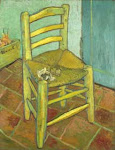
I was all set to blog today about the superb book "The Venus Fixers," until I read this article in today's Times Online: a teaser piece about a forthcoming article in January's Art Newspaper by art critic and van Gogh enthusiast Martin Bailey. In 2005, a superbly researched article by Bailey in Apollo magazine argued that van Gogh may have learned about his brother Theo's engagement the morning of 23 December 1888 and that this news may have been the 'final straw' that led to Vincent's breakdown and self-mutilation that night. (I was so convinced by his theory that I used it in "Sunflowers." Merci, Mr. Bailey!) Bailey's forthcoming article produces additional evidence to support this theory, via a new reading of the one of the first paintings Vincent produced after leaving the hospital early in the new year. "Still Life with Onions" (click image to enlarge) from January 1889 has been seen as a "demonstration piece" (in the words of Douglas Druick and Peter Zegers, in their "Van Gogh and Gauguin: The Studio of the South" exhibition catalogue, p. 168) to prove Vincent's continued ability to paint and as a form of self-portrait, much like van Gogh had done in his famous Chair painting not long before. On the table we see onions (which Vincent in fact added in the background of his Chair painting), Vincent's pipe and tobacco pouch (also in the Chair painting), a lit candle (which appears in the Gauguin's Chair picture), a book about health, an empty bottle of wine, and a letter. (This painting makes a cameo appearance in "Sunflowers," by the way.)
Bailey's new article, of which the Times piece gives only a taste, evidently focuses on the letter depicted in the painting. The envelope is addressed to Vincent and must be from Theo. Bailey demonstrates that the "67" you see on the envelope indicates a post office in the Place des Abbesses, not far from where Theo lived. (Readers of "Sunflowers" know that by coincidence Rachel gains a connection to someplace in the Place des Abbesses late in the book. I can't help but giggle.) He also learned through his research that the special New Year's Day postmark seen on the envelope was placed on Paris mail from mid-December onward. Bailey argues that this letter in the painting is the very one Vincent received the morning of 23 December containing the news of Theo's marriage.
The Times article states, "It is known from a letter he [Vincent] wrote to Theo at the end of January 1889 that he had received what he called 'the much-needed money' on December 23." I scratched my head at this at first, because I didn't remember that detail from Bailey's 2005 article--because it's not there. Up until now, there's been no proof Vincent received a letter that day. That part of Bailey's original theory had to remain speculative. So I ran to my Brand New Shiny Set of Van Gogh Letters (I still need to do a proper review of this masterpiece set of books), and by golly, there IS a new piece of evidence, in the new translation of the letter Vincent sent Theo on 17 January 1889. A crucial difference in the new translation of one sentence in this letter versus the old translation we've all seen in English up until now. Clearly the Times article is leaving out this neato tidbit so as not to steal the fun from the Art Newspaper article, so I'm not going to give the game away either. But heehee hoho, Bailey's theory from 2005 seems poised to be right. Bravo!
I wait with eagerness for the full article...
Wednesday, December 23, 2009
This Day in History...

On 23 December 1888 at 11:30 pm, Vincent van Gogh walked into the brothel at no. 1, Rue du Bout d'Arles in the town of Arles, asked for the prostitute named Rachel and handed her a piece of his ear, wrapped in newspaper. (Click here for a post about our sources for the incident and here for a post about my visit to the Rue du Bout d'Arles in 2007.) Against all odds and expectations, Vincent recovered from his injury and the accompanying psychotic episode, returning to his yellow house in the Place Lamartine just after the new year. The self-portrait pictured here (click to enlarge) was one of the first paintings he made after leaving the Arles hospital. He does not hide what he has done; the bandage is there for all to see. To me this painting is an affirmation -- I am still here, the man in the picture seems to say. I can still paint.
The "ear incident," of course, appears in my novel "Sunflowers." It had to -- Rachel is my narrator. But it proved to be one of the most difficult scenes to write, for two reasons. First, readers' expectations. Most people reading the book know that it's coming. I build up to it for a few chapters; the tension escalates, Vincent becomes more and more unsettled at events in his life. The scene needed to live up to what readers would expect -- it needed to be dramatic, it needed to be a true turning point in the story and in Rachel's character development. But -- the second reason it was difficult -- it had to be told in a convincing way. Think about it: he gave her his EAR. How do you write that in a way that's not too gory or worse, too campy? Tell it badly, and the reader's going to snicker: popular culture makes enough jokes about Vincent's severed ear. The scene underwent a few drafts before I reached a tone and narrative I was happy with. I aimed for spare prose, using as few words as possible, and I decided to use the fact that readers already know what's in that package. How? Read the book and find out! :-)
Friday, December 18, 2009
Parlez-vous provençal?
Readers of “Sunflowers” will notice the occasional word/phrase in French sprinkled in for flavor, but also the occasional word/phrase in Provençal — a separate language that today is spoken by a minority but in van Gogh’s time was experiencing a virtual renaissance. Provençal is a dialect of the language termed Occitan by modern linguists and known in French as la langue d’oc. Gascon and Auvergnat are likewise dialects of Occitan, but there are many others throughout southern France, as well as parts of northern Italy, Monaco, and Spain. Historically there were two major languages in France: the langue d’oc (spoken in the south) and the langue d’oïl (spoken in the north). Both are Romance languages rooted in Latin and the Roman occupation of Gaul. In the sixteenth century, the Edict of Villers-Cotterets decreed that the Northern langue d’oïl should be used for all administration; modern French thus derives from one of the oïl dialects. In fact, the closest linguistic cousin of the southern Occitan language is not modern French, but Catalan! The Provençal dialect of Occitan is native to southeastern France, and within it are variant sub-dialects. Two of these are the Rodanenc or Rhodanien sub-dialect, found around the Rhône River in cities such as Nîmes, Arles, and Avignon; and the Maritim or Centrau sub-dialect, found in the area of Marseilles and Aix-en-Provence.
In van Gogh’s time, the Provençal language was gaining increased attention thanks to the efforts of writer Frédéric Mistral and the Félibrige movement he founded in 1854. The Félibriges sought to revive Provençal literature and culture after decades — even centuries — of oppression by the French government. During and after the French Revolution in particular, Occitan and its dialects were forbidden in all official capacities. Young boys and girls (like Rachel) growing up in Provence in the nineteenth century would have learned only French in school, although they most likely spoke Provençal at home. Mistral aimed to counteract these developments, as he and other authors published books and poems in Provençal and worked to revive traditional customs and dress. Under the direction of the Félibriges, new dictionaries and grammars of the Provençal language were created. In Arles, Mistral founded the Museon Arlaten — which still exists today as a celebration of traditional Provençal culture — and a statue of him stands prominently in the city.
Van Gogh was fluent in French but knew no Provençal upon arriving in Arles. He claimed in his letters to Theo that his deficiency in the language caused problems and that many Arlesiens could not understand him. He was aware of the Félibrige movement, however, and mentioned it in his letters, while in January 1889, he attended a performance of a traditional Provençal pastorale (Nativity play) in the native language. It is unclear whether Vincent learned any spoken Provençal during his two years in the south of France, although it’s likely he picked up a few words and phrases given his flair for languages. He did very much admire the traditional Arlésienne dress promoted by Mistral and his colleagues...more on the the lovely Arlésiennes another day!
Saturday, November 21, 2009
Meet Monsieur Roulin

One of Vincent's closest friends in Arles -- and a critical character in "Sunflowers" -- was Joseph-Etienne Roulin, an entreposeur des postes (postal agent) who worked at the railway station. We first learn of Monsieur Roulin in a letter to Theo from the end of July, when Vincent enthusiastically describes the subject for a new painting (the painting seen here, click to enlarge). We're not sure when the two men actually met, but the place was likely the Café de la Gare, where Vincent was living at the time. Both men were habitués of the café, Roulin living only a short distance from Vincent; van Gogh would later say that Roulin accepted drinks as payment for modeling. Over time Roulin would be the subject of several paintings and drawings by Vincent (so would all the members of his family), but this first painting remains my personal favorite. Today in the Museum of Fine Arts, Boston, the canvas shows Roulin proud in his uniform, cozied up to a table as if ready for a mug of beer. Roulin posed a bit stiffly for it, Vincent would complain to Theo, but still, the face shows the calmness and wisdom that would serve Vincent well in the months to come.
We know from surviving letters -- Vincent's letters and those of Roulin himself -- that Roulin and his wife remained supportive of Vincent throughout his time in Arles. According to the memoirs of Johanna van Gogh-Bonger (Theo's wife), Roulin was in the brothel the night of 23 December 1888, when Vincent appeared with the piece of his ear, and helped Vincent out of there. While Vincent was in hospital during that first breakdown, Roulin and his wife Augustine both went to see him; Roulin in turn sent letters to Theo and Vincent's sister Willemien updating them on his condition. It was Roulin who apparently met with the head of the Arles hospital and persuaded him to release Vincent, when debate was being held about committing Vincent to an asylum. Even after Joseph Roulin was transferred to Marseille in January 1889 (one of the few chronological changes I made in "Sunflowers" was keeping him in Arles until August 1889), he still kept contact with Vincent. The rest of the Roulin family remained in Arles until October 1889, when Monsieur Roulin was able to move them to Marseille, and they too seem to have kept contact until Vincent left for Saint-Rémy in May 1889. Conspicuously absent from the signed petition of March 1889 -- in which many of the Arles townspeople tried to have Vincent forcibly committed -- are any names from la famille Roulin. In his letters, Vincent speaks of the Roulins as a model family, praising Joseph Roulin in particular for his wisdom, his politics (he was an "ardent republican," according to Vincent), and his fatherhood. "A good soul," Vincent calls him, and elsewhere says Roulin as an artistic subject is "in the manner of Daumier."
One of the treats of the Van Gogh Museum's new translations of Vincent's correspondence is the publication in English for the first time of more Roulin letters: four letters sent to Vincent by Joseph Roulin while the former was in the asylum at Saint-Rémy and the latter was in Marseille. These letters not only reveal that Vincent maintained correspondence with his friend during this time (unfortunately Vincent's letters to Roulin do not survive), but also the depth of their friendship. "Monsieur Vincent," Roulin calls van Gogh with respect, his words leaving no doubt of his high regard for the painter. We learn from these four letters that Vincent must have had good relations with Roulin's children, for Roulin gives newsy accounts of their activities, especially the then-toddler Marcelle. Roulin's notes to Vincent are reassuring, telling him that he is in beautiful country at Saint-Rémy, encouraging him to paint. Indeed, these letters suggest that Roulin and Vincent talked about painting quite a bit. Vincent certainly gave the Roulins paintings; Roulin talks about the portraits Vincent had given them and the pleasure the pictures give his family.
In the last letter surviving from Roulin to Vincent, dating from late October 1889, Roulin says, "let us hope that one day again we shall have the happiness to shake hands and to tell each other in person such good things and to cement our friendship once more; I am confident and am full of hope to see you again one day." Unfortunately for the two friends, it never happened.
Thursday, October 22, 2009
*The* Newspaper Article

Since this weekend's Festival of Reading is sponsored by the St. Petersburg Times, it only seems appropriate to post about THE newspaper article that best records the notorious "ear incident" and that inspired the writing of Sunflowers.
Pictured here is a clipping from Le Forum Republicain, the Sunday newspaper of Arles. The article is from the 30 December 1888 edition, one week after Vincent's self-mutilation. The article begins, "Last Sunday at 11:30pm, one Vincent Vangogh[sic], painter of Dutch origin, presented himself at the maison de tolerance no. 1, asked for one Rachel and gave her...his ear, saying 'Guard this object very carefully.' Then he disappeared." The article goes on to explain that the police went to Vincent's house and found no sign of life in the patient, then that he was taken to hospital.
The clipping as pictured here is misleading, as I discovered in my research for the book. I'd always seen the article photographed this way--the same picture appears in all the van Gogh literature--so I assumed it was the 'top story' in the paper that week. It wasn't. The "Chronique locale" (local news) section is actually on the back page. The news item about Vincent was not as prominent as it appears in this photograph; the original photographer cut and pasted the newspaper for the picture. Even so, it's easy to imagine shocked faces around the breakfast table that particular Sunday. All the more so considering that Le Forum Republicain had featured multiple editorials in the past about the prevalence of brothels and unregistered streetwalkers in the town. Even though prostitution was legal in the sense that it was regulated by the government (with strict laws), many townspeople did not approve. Of especial concern, it seems, were the number of prostitutes illegally frequenting the cafes around the Arles train station, in other words, the area where Vincent lived.
The article is noteworthy as the only known historical document that calls Rachel by name. The observation that Vincent asked for her specifically at the brothel reveals he knew her, and my question is, How much and how well? That question inspired the story that emerges in Sunflowers.
Thursday, October 8, 2009
Meet Van Gogh's Doctor

Holly over at Wonders and Marvels very kindly invited me to contribute a guest post about Sunflowers -- I opted for "Meet Van Gogh's Doctor," since W&M often has medical-themed posts. Holly, aka Prof. Tucker of Vanderbilt University, is a historian specializing in things scientific and medical. She is also offering a giveaway of Sunflowers -- click on the bookcover to enter. The giveaway closes on October 14th.
Stop by Wonders & Marvels to learn more about Dr. Felix Rey, the physician in Arles who treated Vincent after the "ear incident." Seeing his portrait at an exhibition in The Metropolitan Museum of Art in 2007 inspired an entire subplot in the novel!
Thank you, Holly, for the invitation to post, and thank you, Tina, for getting it up there.
Thursday, August 13, 2009
A Van Gogh Mystery
Police in Santa Fe are asking for the public's help with a burglary from an artist's home of about $750,000 worth of artworks, jewelry, and artifacts, including an alleged charcoal drawing by Vincent van Gogh. The Santa Fe New Mexican posted an article today about the heist but unfortunately provides no photographs of the drawing. The homeowner describes the drawing as a 14-by-17 inch charcoal preliminary sketch of the "Night Café" painting in the Yale University collection (the same painting that currently is entwined in its own legal battle) and says it is identical to the painting except that it lacks VIncent's signature.
This story intrigues me, and not because of the theft. This drawing -- if it is indeed by van Gogh -- is unknown in the canon, as far as I've been able to find out. It is not in the de la Faille catalogue raisonné, and it is not mentioned in the scholarship surrounding the Night Café painting. The homeowner says that his great-grandfather bought the drawing and it has been in his family ever since: how can van Gogh experts not know about it? And another point ... when Vincent was living in Arles in September 1888, at the time he did the Night Café painting (and the watercolor version of the painting today in a Swiss private collection), his drawing materials of preference were pencil and/or ink/reed pen. Not charcoal.
I would really like to see a photograph of this drawing. According to the article, experts at Yale have been brought into the case. I would also really be curious to know what they have to say.
UPDATE (20 Sept 2009): On 9/11 the Santa Fe New Mexican reported that the alleged van Gogh drawing was discovered, along with the other artworks allegedly stolen from the home, at a consignment shop in Raton, on sale for $250. The whole thing smells odd to me: to quote John Turturro in "Oh Brother Where Art Thou" -- "That don't make no sense." Among the comments on the article about the recovery (which are otherwise pretty silly), David Brooks from the online Van Gogh Gallery (www.vggallery.com, the best non-museum Van Gogh site there is) rightly points out that "There is no such known van Gogh drawing. Saying it's a van Gogh doesn't make it a van Gogh." He's got that right.
Friday, July 17, 2009
Summer of Love

The summer of 1888, spent in Arles, was one of the most productive times of Vincent's career -- and one of the times when he was most happy. Harvest time in June resulted in a bevy of paintings and drawings, and even when the harvest was done, Vincent roamed the countryside around Arles looking for new subjects under the sun. He loved summer "like a cicada," he told his brother Theo, and the locals must have wondered at the foreign redhead painting for hours in the heat. It was the colors of the Provençal summer that inspired him: the rich golds and greens, bright flowers in a rainbow of hues...it's no wonder that the Arles paintings today tend to be the most popular among art lovers.
In July 1888, Vincent tried painting a new subject, one that he would intermittently return to for the rest of his time in Arles. The painting shown here depicts a corner of the public garden in the Place Lamartine, the square near the railway station where Vincent lived. (In July he was still living above the Café de la Gare, although already using the lower rooms of the Yellow House for studio space.) Scholars have even identified *which* corner: on this map, look for the sliver of park just north of where it says "Roubine du Roi canal." The entire square lay outside the medieval city walls and was part of the town's expansion around mid-century; according to Arles city records, the garden was planted in 1873. Vincent describes this painting to his sister: "I have also got a garden without flowers, that is to say a lawn, newly mown, bright green with the gray hay spread in long streaks. A weeping ash and a number of cedars and cypresses, the cedars yellowish and spherical in form, the cypresses rising high into the air, blue-green. At the back, oleander and a patch of green-blue sky. The blue shadows of the shrubs on the grass." (W5)
Vincent did another series of four paintings of the garden in the autumn, and a number of drawings spread over the time until he left Arles in May. He came to call this place "a poet's garden," associating it with the poetry of Petrarch and Boccaccio...love poetry. Is it a coincidence that just on the other side of the canal and the city wall lay the brothel district, the place Vincent called "la rue des bonnes petites femmes," the street of the good little women? Rachel's brothel, for instance, was located at the north end of the Rue du Bout d'Arles (marked on the map). Did Vincent somehow associate this lush garden with the women he met in the brothels? One can only speculate.
Unless one is writing fiction. In which case, you can make it so!
Tuesday, May 5, 2009
Another Ear Theory
Two German art historians are proposing another possibility for Vincent's mutilated ear: that Gauguin did it (see the Guardian article). The book "Van Gogh's Ear and the Pact of Silence" suggests that Gauguin injured Vincent with one of his fencing swords during a fight, either accidentally or intentionally. The two artists, according to this hypothesis, agreed to keep the incident a secret. Now, I am not a big fan of Gauguin and think Vincent's life would have been very different had he not come to Arles, but I am not persuaded. First of all, given that Vincent's ear was sliced only partially, that would have been quite a feat with a fencing sword. Especially 'by accident.'
The Guardian also published a rebuttal blogpost by art and design critic Jonathan Jones.
UPDATE: The Daily Mail also has an article about the new book (thanks for the link, Julianne!) and reveals more of the theory: that the alleged fight between Gauguin and van Gogh was about Rachel. I still am not persuaded Gauguin wounded Vincent with a sword, but otherwise the connection with my novel is really fun...and that's all I'm saying...
UPDATE 2: Wow, this story is being picked up by a lot of news outlets. It's not every day Vincent winds up on TMZ. Martin Gayford, author of the book "The Yellow House," has a rebuttal at Bloomberg.com that I think is spot on (although I think he favors Gauguin more than I do...).
Wednesday, March 25, 2009
Yale Fights for the "Night Cafe"

Yale University filed a lawsuit in a Connecticut federal court yesterday to assert its ownership of van Gogh's "Night Cafe in the Place Lamartine," the Associated Press has reported. Yale's move is intended to counteract possible legal action by Pierre Konowaloff, the great-grandson of Ivon Morozov, who owned the painting in 1918. As the AP report explains, Morozov's estate, including the "Night Cafe," was nationalized during the Communist Revolution. Konowaloff claims that the Soviet government did not have legal title to the painting and therefore had no right to sell it. In contrast, Yale's lawsuit claims that no international laws were violated when Russia nationalized Morozov's and other art collections, and that Konowaloff has no ownership rights.
Art collector and Yale alumnus Stephen Carlton Clark acquired the "Night Cafe" from a New York gallery in 1933 or 1934, then included the painting in a bequest to Yale in 1961. Recently an exhibition at the Metropolitan Museum celebrated the Clark brothers' art collection; the "Night Cafe" was a highlight of the show. The Yale lawsuit points out that neither Morozov's widow nor Konowaloff's parents made any claim on the painting at the time it was acquired by Yale University and the bequest highly publicized. The university argues that Konowaloff can recover neither the painting nor its equivalent value since he failed to take action during the three-year period following Yale's acquisition.
A fascinating case to watch!
Saturday, March 21, 2009
Hello, Spring

Living in Florida -- where there are really only two seasons, summer and not-summer -- it's easy to forget the first day of spring. Even the television weatherpersons announce the day in a blasé, bemused way, as if it's only a formality after weeks of temperatures hovering around 80.
But still, the arrival of spring deserves a special tribute, and what better than one of van Gogh's flowering orchard canvases from Arles? He painted over a dozen of them in late March-April 1888, pear, plum, apricot and peach trees, explosions of blooms and colors. Subconsciously they likely reflected his feeling of rebirth, arriving as he had in February after two difficult years in Paris. Quite consciously, they reflected Vincent's fascination with Japanese art: artists like Hiroshige made flowering trees a key motif in their ukiyo-e prints. Vincent knew these well, for many beautiful examples formed part of his and Theo's Japanese print collection. Vincent may also have been thinking of one of his heroes, Jean-François Millet, whose lovely "Spring" canvas had entered the Louvre in 1887, while Vincent was still in Paris. (Today "Spring" is in the Musée d'Orsay: see Catherine Delors' blog for a tribute.)
I saw the Van Gogh Museum's collection of flowering orchards in 2007, but I chose my favorite at the Kröller-Müller Museum during that same trip to the Netherlands -- this one, "Peach Trees in Blossom," also known as the "Souvenir de Mauve" (click image to enlarge). I know I say this all the time, but a photograph cannot capture the colors and texture of this picture. It was easily my favorite painting in the entire Kröller-Müller. I could not tear my eyes away. The graceful arc of the tree trunk, the way the flowers stretch to the sky...lovely. Vincent himself thought it the best of the paintings he had done up to that point in Arles, and for that reason, he chose it to send to Jet Mauve, the widow of Dutch landscape painter Anton Mauve, when he learned of Mauve's death. Vincent had known Anton Mauve in The Hague; Mauve had been a mentor and teacher before the two had a falling-out over Vincent's relationship with prostitute Sien Hoornik. It is fair to say that Mauve's work and guidance helped shape Vincent's approach to landscape painting, and Vincent wrote to Theo that he was "choked with emotion" after hearing of Mauve's passing. In typical Vincent fashion, sending the painting to The Hague had a pragmatic angle too: he confided to Theo that the gift "might really break the ice in Holland," in other words, help gain exposure for his work in the brothers' homeland.
After choosing the painting to send, Vincent inscribed it "Souvenir de Mauve" (Remembrance of Mauve) together with "Vincent & Theo." But Theo's name is no longer there, and it is thought Vincent removed it at his brother's request. The painting has never been restored, but the colors are still fresh, whereas in some of the other orchard paintings Vincent's pinks have faded to white.
Happy Spring!
Saturday, November 15, 2008
The Novel Reader

Around mid-November 1888, while in Arles, van Gogh painted this "liseuse de romans," or novel-reader, today in a private collection (click on image to enlarge). She is rendered in a sketchy, expressionistic style and seems to have been an experimental piece on Vincent's part, namely because he was not working from a model, his usual practice. He painted this figure from his imagination, and if he based her on someone he knew, we don't know her identity. In the letter to his sister Wilhemina in which he describes this picture (W9), Vincent mentions his house-guest, Paul Gauguin, adding that Gauguin "strongly encourages me to work often from pure imagination." As someone who preferred to base his pictures in something tangible, even if he altered reality in the end, Vincent found this technique "de tête" a challenge.
Particularly noteworthy here is the book in the woman's hands. To a viewer of our time it seems innocuous, but a viewer of Vincent's day would instantly identify the book as a "modern" novel, typically published as yellow-covered paperbacks. Books are a recurring motif in van Gogh's work; often he depicts the novels that he enjoyed so much, by authors like Zola or the Goncourts. But such novels were acceptable reading for a man -- not for a woman. Vincent differed from most men of his time in believing women *should* read modern novels, so they themselves could be modern in thinking and worldview. As art historian Judy Sund* says it, for "this imagined female...[to be] reading a yellow book (i.e. a modern novel) with wide-eyed attention reflects the artist's conviction that everyone should read, and suggests anew that his conception of the ideal woman included a devotion to the modern fiction that was modelled on his own" ("Favoured Fictions," p. 260). Vincent's surviving letters to his sister Wil include many reading recommendations. In the letter mentioning "La Liseuse de Romans," he says, "It is a very good thing that you have at last started to read Au Bonheur des Dames" [a novel by Emile Zola about a girl working in a Parisian department store]. We can contrast Vincent's attitude with his brother Theo, who says in a letter to a female acquaintance (T1a), "...so many fine things are written that one can hardly discuss, at least with ladies. Zola, Guy de Maupassant and others will go on belonging to the forbidden fruits for a long time to come." One wonders what he thought of Vincent's encouraging Wil to read exactly those books!
*Judy Sund, "Favoured Fictions: Women and Books in the Art of Van Gogh," Art History 11, 2 (June 1988) 255-267.
Wednesday, September 24, 2008
The Other Starry Night

Visitors to MoMA's "Van Gogh and the Colors of the Night" will be able to see one of my personal top 3 van Gogh paintings, "The Starry Night over the Rhone," painted in Arles in late September 1888. The painting belongs to the Musee d'Orsay in Paris but travels quite a bit for various exhibitions.
A photograph cannot do this painting justice. There's such movement, such texture in the way the paint is built up on the surface of the canvas, that (as with most van Goghs) you want to reach out and touch it. I first saw this painting in person in 1996 at the Orsay, and it took my breath away. Every subsequent viewing, I've discovered something new. I love it so much I gave its creation a whole chapter in my novel!
In Arles, you can stand on the very spot where Vincent painted his picture, today marked with a poster. (I did this, of course!) The skyline looking downstream as Vincent saw it actually hasn't changed all that much. But Vincent took liberties with the sky: as Charles Whitney explained in his 1986 journal article "The Skies of Vincent van Gogh," the Big Dipper (or as Vincent referred to it in a letter to Theo, the Great Bear) is a constellation of the northern sky, whereas Vincent is facing to the southwest. Presumably he turned toward the north while working to observe the stars, then created this composite scene. But why? Prof. Whitney in his research learned that the southwestern sky in Arles at the time Vincent created his painting was not very exciting, with only a few stars; moreover, there was a full moon around that time, which would have been visible to the south. For whatever reason, Vincent opted not to paint the moon (which in other pictures, he likes) and instead chose the stars. The fact there was a full moon debunks a common myth: that Vincent painted outside in Arles with candles stuck in his hat (we see this in the film version of "Lust for Life," for example). He wouldn't have needed it.
As for the couple in the foreground, described by Vincent in a letter to Theo as "two colorful little figures of lovers": happy couples with linked arms were a motif in Vincent's work while in Paris and Arles. In some cases, as here, the man is shown with a yellow straw hat, and it is tempting to see the painted couples as Vincent's wishful thinking. (In my novel, I have some fun with the painted couples...)
Vincent was very proud of this picture and held it in higher esteem than the more famous Starry Night (painted in June 1889). It was even exhibited, together with the Getty "Irises," in the Salon des Independents in Paris in fall 1889. It did not sell, and we learn later that Theo and his bride Johanna hung the Starry Night over the Rhone in the salon of their Paris apartment.
Thursday, June 12, 2008
Blog Makeover
I must be in a procrastinating mood to spend time figuring out how to insert a picture in the header and then pick one out. But voilà! Instant makeover!
The header picture is a detail from Vincent's May 1888 "View of Arles with Irises" (I've cut the irises, which are at the bottom of the original painting). The view is from a field in the south of town; the towers of the church of Saint-Trophime are visible in the skyline. Vincent, in writing about this painting to Theo, said: "A little town surrounded by fields all covered with yellow and purple flowers, exactly--can't you see it?--like a Japanese dream" (LT487). He loved this painting enough to write about it to his friend Émile Bernard too, saying, "What a subject, eh! That sea of yellow with a band of violet irises, and in the background that coquettish little town of the pretty women!" (B5).
This painting today is in the Van Gogh Museum--the family never parted with it. It was out on loan last year when I went to Amsterdam, and I was delighted to find it in the "Van Gogh and Expressionism" exhibition in New York later in the summer. It's one of my favorites for its colors and composition.
Saturday, May 17, 2008
New Discoveries at Arles

I am slipping on my classicist's hat today to comment on the exciting new archaeological discovery near Arles: four sculptures, found at the bottom of the Rhone River, including a striking bust thought to be Julius Caesar himself (pictured). Luc Long, the archaeologist supervising the excavation, dates the bust to about 46 B.C. and believes it may have been tossed in the Rhone in the turbulent times after Caesar's assassination in 44 BC. Without an inscription it is difficult to confirm the Caesar identification, but it's definitely likely: Arles (Roman Arlate) was founded at Caesar's direction, and the style of the portrait, with its strong signs of aging and close-cropped hairstyle, puts it squarely in the Republican period. (I'd like to see a profile view to compare to images of Caesar on coins, but nobody's posted one.) Also found were a 5.9 ft statue of Neptune--appropriate deity for a town involved in maritime trade--and two smaller bronze statues, one described as a satyr with hands tied behind his back (likely Marsyas, I'm thinking). The statues will go on display in the fantastic antiquities museum there at Arles (which is definitely worth visiting). They remind modern-day viewers that in Roman times Arles was the greatest city in Gaul and one of the most important cities of the empire.
Monday, April 28, 2008
Visiting Arles
In response to a commenter's question (Hi, Margaret!), here's a post about visiting Arles, for you holidaygoers out there. I spent a week in May 2007, mainly focusing on van Gogh research but hitting other things too. A week is probably too long for most visitors, but there is plenty to see to occupy a few days.
VAN GOGH SITES: The yellow house, Rachel's brothel, and the night cafe of the Place Lamartine are all gone, victims of World War II. But there are other van Gogh related things to see: you can pick up a map with a self-guided walking tour at the tourist office on the Boulevard des Lices (near the Carousel). Posters around town mark the sites of some of the paintings, including a favorite of mine, Starry Night over the Rhone. The former hospital is now a cultural center (Espace van Gogh--ahh, the irony that it's named after him!), and the courtyard garden is recreated to look like Vincent's painting of it. The cafe in the Place du Forum painted by Vincent is still there, the space under its yellow awning now taken up by Vincent fans, not locals. (Tip from me to you: have a coffee or a drink here only.) The ancient cemetery known as the Alyscamps, painted by both Vincent and Gauguin (Gauguin doesn't have any posters around town, heehee), is a short walk outside the town center and worth a visit. Trivia: the McDonald's on Boulevard des Lices is filled with tile versions of van Gogh paintings (found this out by accident and was too embarrassed to take pictures!).
THINGS MEDIEVAL: The church of Sainte-Trophime on the Place de la République was the starting point of one of the medieval pilgrimage routes to Santiago de Compostela and is worth seeing. The sculptures of the Last Judgment on the facade were recently cleaned and look great. Hotel le Cloitre, my hotel in Arles, is adjacent to Sainte-Trophime.
THINGS ROMAN: Can't get away from the Romans: the amphitheater, the theater, bits and pieces stuck into buildings around town. The fairly new ancient art museum outside the town center is fantastic and definitely worth visiting for anyone interested in ancient things. (Tip: Do not try walking there. You will not find it. Drive or take the public bus.) Tourist office has brochures for medieval things to see and Roman things to see. I'm hitting the high points here.
BEST MEAL IN TOWN: The Jardin des Arts across from the Museon Arlaten. Charming atmosphere, delicious food, not touristy (unlike every restaurant on the Place du Forum). I ended up eating here three times 'cause it's so good. (Twice I had the sublime farfalle ortolana pasta. Desserts are amazing.)
OTHER THINGS TO DO: The Museon Arlaten is worth seeing for anyone interested in Provençal folk culture. The young ladies serving as guards wear 19th century style traditional Arlésienne dress, which ended up being part of my research! On Saturday mornings, a big market takes over the Boulevard des Lices: food items, local crafts and such, and mishmash garage-sale type items. I bought soap, spices, lavender, etc. Had brief moment of horror upon realization that cuddly bunnies in cages at a certain booth were not pets. !!
DAYTRIPPING: Arles makes a good base for nearby places, most notably the charming Saint-Rémy-de-Provence, reachable by car or public bus. Vincent spent a year in the asylum at Saint-Rémy, which can be partly visited (it's still a hospital). The Roman site of Glanum is next door to the asylum (Vincent was walking over it and didn't know it -- excavations began in the 1920s), and the town itself makes for a pleasant day. One can also get to Nîmes from Arles (I took the bus), home to some nice Roman ruins, and by car you can visit the town of Les Baux, not far away.
Subscribe to:
Posts (Atom)
